


A smart thermostat and a smart radiator valve are related but they each solve a different problem. In a lot of homes, the honest answer to “which one should I buy?” is both. If you’re starting from scratch, our guide to the best smart thermostats is worth a look before you commit to either camp. Once you know what each one’s actually in charge of, and where the line between them sits, picking between them gets a whole lot easier.
What is a smart thermostat?
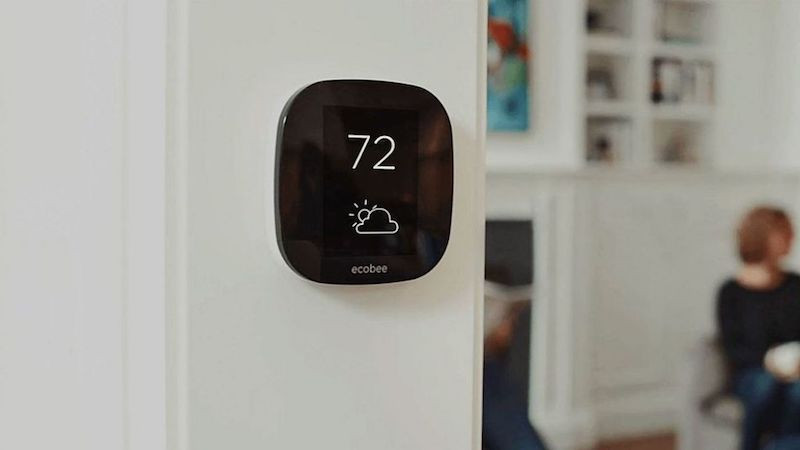
A smart thermostat is a whole-home control. It sits in one location, usually a hallway or living room, reads the temperature there, and uses that single reading to decide whether your boiler fires up or not. When the boiler turns on, every radiator warms up, and the boiler shuts down when the thermostat hits its target temperature, regardless of the individual temperature in each room.
Devices like Ecobee’s SmartThermostat or Tado’s Smart Thermostat fit this description. They add scheduling, geofencing, and app control on top of that basic job, but the underlying mechanic hasn’t changed since the wall-mounted dial: one sensor, one target temperature, one decision about whether the whole system runs.
What is a smart radiator valve?
A smart radiator valve, or smart TRV, works at the opposite end of the system. It replaces the manual or thermostatic valve on an individual radiator and controls the temperature of that room, independent of every other room in the house.
Depending on the system you have, a smart TRV can control the boiler (calling for heat) or it can only control the temperature of the room while the heating is on.
Buy a Tado X system, for example, and the TRV can call for heat. That means that when a room is cold, the TRV opens up and turns the boiler on. When the room is at temperature, the boiler is told to shut down. With smart TRVs in each room, each can call for heat when required, so each room gets to its ideal temperature based on its own individual schedule. This kind of system can save you money, as you only need to heat the room you’re in.

The Tado X smart TRV, along with other products, such as the Aqara Radiator Thermostat W600, can also work without boiler control. In this mode, a central thermostat has to turn the heating on. But, while the heating is on, the smart TRV provides more nuanced control over a room’s temperature.
For most people a full system with boiler control is best, but the latter is good for renters: you can leave the current heating system in place, but make sure that each room is controlled to hit the temperature that you want. If you’re not renting and have control over your home’s heating system, it’s better to buy a system with full boiler control.
Do you need both a smart TRV and a smart thermostat?
No, you don’t. With the Tado X system, and similar, you can just use smart TRVs and they’ll control everything with no smart thermostat required.
However, you may want to buy wireless temperature sensors to go with your system. These look like wireless thermostats, but their job is to monitor the temperature in a room and shut down a smart TRV (or multiple ones if you have more than one radiator in a room).
These wireless sensors are useful if your smart TRV gets the temperature wrong: it’s in a draught or behind furniture, for example.

Do you need a smart TRV on every radiator?
For the ideal level of control, you do. If you don’t, then a smart TRV in another room can call for heat, and the radiator without a smart TRV will also warm up. There’s a risk that the room withour a smart TRV will get too hot.
There’s some advice to say that you should leave one radiator without a TRV so that a boiler has somewhere to push hot water while it cools down. However, modern boilers don’t need this, and smart TRVs understand how to run a heating system.
Are smart radiator valves worth it?
If you want each room to be at the ideal temperature, then yes. Smart TRVs also have the advantage that you can just heat the room you’re in, which is cheaper than heating your entire home. And, if just one radiator is on, the hot water runs there quickly, so the radiator warms faster.
Cost and installation: smart TRV vs smart thermostat
A smart thermostat is usually the simpler starting point. Installation is often a same-afternoon job, although you may want a plumber to do the job.
Smart radiator valves are DIY-friendly individually, generally just an unscrew-and-replace job with a bit of app pairing, but the cost adds up fast across a full house. Fitting smart TRVs to every radiator in a typical home, plus the hub most systems require to run them, commonly runs well into four figures once you’ve covered eight, ten, or more radiators. That’s before factoring in that most valves work best, or only work fully, alongside a thermostat or hub from the same manufacturer, so the ecosystem you pick for one tends to decide the other.
Ecosystem and compatibility
You only get the full scheduling control if you use the thermostat or smart TRV’s app. However, having Matter compatibility can be useful for automation, say turning the heating off if nobody is in a room, as measured by a presence sensor.
Can you control underfloor heating with a smart TRV?
No, but full systems that support TRVs also support underfloor heating. For most systems, you’ll need a smart relay that can turn on the two-port zone valve to your underfloor heating, and also call for heat.
If smart TRVs are so good, what’s the point of a smart thermostat?
A smart thermostat is a simpler device and well suited to smaller homes. And, there’s less maintenance, too: with a smart thermostat you only have to worry about batteries in that one device; with smart TRVs, each device has its own battery. A smart thermostat is also a lot cheaper.