


Unifying your smart home all under one app with one hub to do the heavy lifting makes a lot of sense. When it comes to the widest device support, there are two hubs that stand out, the Homey Pro 2026 and the Aeotec Smart Home Hub (previously called the Samsung SmartThings Hub).
The Aeotec makes sense if you already use Samsung SmartThings and want an affordable, dependable way to add Zigbee and Z-Wave devices. The Homey Pro 2026 is for enthusiasts who want more protocols, deeper automations and a hub that isn’t tied to one platform. We’ve reviewed both, and here’s how they compare.
Design
- The Aeotec Smart Home Hub has a built-in Ethernet port; the Homey Pro 2026 needs an optional adaptor for a wired connection.
- The Homey Pro 2026 looks exactly the same as the Homey Pro Early 2023.
- The Aeotec hub is physically identical to the Samsung SmartThings Hub V3, apart from the branding.
Neither hub stands out for its looks, but the Aeotec has one practical advantage: a built-in Ethernet port.
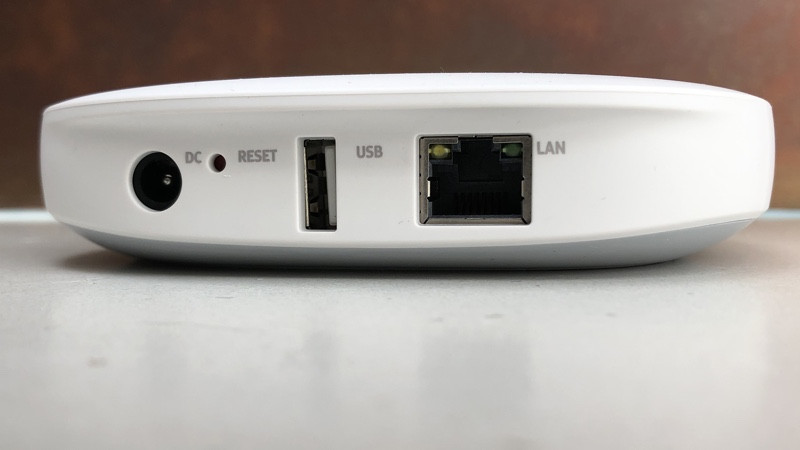
The Homey Pro 2026 has dual-band Wi-Fi 5, and you need to buy a separate adaptor if you want a wired connection. That’s an odd omission on such an expensive hub, particularly as the cheaper Homey Pro mini has Ethernet. The Aeotec plugs straight into your router, with Wi-Fi as a fallback.

The Homey Pro 2026 is also identical on the outside to the Early 2023 model, which feels like a missed chance for a refresh. The Aeotec is no more original, since it’s a SmartThings Hub V3 with a new badge, but at least it gives you the wired option.
Winner: Aeotec Smart Home Hub
Protocol Support
- The Homey Pro 2026 supports Zigbee, Z-Wave, Thread, Matter, 433MHz and IR. The Aeotec handles Zigbee and Z-Wave, plus Thread and Matter following a firmware update.
- The Homey Pro 2026 has 4GB of RAM, double that of the Early 2023 model, which raises the app limit from 60 to more than 100.
- The Homey Pro 2026 can’t join an existing Thread network, which can limit range.
The Homey Pro 2026 covers more ground here. It supports Zigbee, Z-Wave, Thread, Matter, 433MHz and infrared in one box, with cloud connections for anything that can’t connect directly. And, Homey Pro supports community integrations. For example, my Ring Alarm is connected via a third-party integration.
The Aeotec Smart Home Hub covers Zigbee and Z-Wave, and there’s now Thread and Matter support through a firmware update. Beyond that, it relies on cloud accounts for big names such as Nest, Ring and Arlo. That works, but part of your home then depends on other companies’ servers.
Homey has its own Thread problems. Zigbee and Thread share one radio, and the hub can’t join an existing Thread network, so range can suffer: I couldn’t get my Ultion Nuki smart lock to connect directly. Even so, 433MHz and IR support, plus a much bigger app library, give Homey the edge.
Winner: Homey Pro 2026
Features
- The Homey Pro 2026 works with Ring Alarm through a community app. SmartThings has a third-party Ring integration, but it isn’t easy to install.
- Homey’s advanced Flow editor uses flowcharts, with multiple triggers, waits and custom variables.
- On the Aeotec the advanced features are no longer available
Both hubs can run complex automations, but they get there differently. The Aeotec Smart Home Hub relies on SmartThings, which handles the basics well: grouping devices into rooms, controlling lights and triggering actions from motion or door sensors. You used to be able to add the powerful WebCORE plug-in for advanced, script-based automations, but the update to SmartThings means that option is no longer available. Stick to the basics and you’re fine, but SmartThings has lost some power in an effort to become easier to use.
On the Homey Pro 2026, the power is built into Flows. These can be basic (unlocking the front door turns off an alarm, for example), but Flows are very powerful thanks to And conditions. For example, the garden lights only come on when the garden office door locks after sunset. The advanced Flow editor goes further, with flowcharts, multiple triggers, waits and custom variables, and no plugins required.

Winner: Homey Pro 2026
Device Compatibility
- Homey’s official and community apps covered every device in our reviewer’s home, including a second-generation Ring Alarm.
- With the Aeotec, SmartThings support is good but not as extensive
The Homey Pro 2026 works with a wide range of devices through its official and community apps, enough me to retire a Raspberry Pi running Homebridge for use with Apple Home. It also exposes more device triggers than other platforms. A Tado X sensor in Homey offers temperature, heating and humidity triggers, where as Apple Home offers either temperature or heating status.
The Aeotec Smart Home Hub is more patchy. Big-brand companies are generally well supported, but there are gaps, such as no Ring Alarm support, and third-party support is practically non existent now.
Winner: Homey Pro 2026
Upgrade Path
- The Homey Pro 2026 can restore from a cloud backup of an older Homey hub, and your devices reconnect automatically.
- SmartThings V1 hub owners have to delete and re-add every device to move to the Aeotec.
- There’s an automatic migration tool for SmartThings V2 and V3 hubs.
Moving to the Homey Pro 2026 is easy. Back up your old hub (Homey’s cloud backup is a cheap paid monthly service), restore it to the new one and give your devices a few minutes to reconnect. Moving to the Aeotec is harder. SmartThings V1 owners have to remove every device and pair it again, one at a time. V2 and V3 owners get an automatic migration tool. The Aeotec also adds no new features over a V2 or V3 hub, so existing SmartThings users have little reason to switch.
Winner: Homey Pro 2026
Value
- Homey also sells the cheaper Homey Pro mini for homes with fewer devices.
- Many new devices connect over Wi-Fi or through their own hubs, so you may not need the Aeotec at all.
- SmartThings has lost features since the switch from its Classic app.
Neither hub is an automatic buy. The Homey Pro 2026 is worth it if you have lots of devices or have outgrown an older Homey hub. For smaller setups, the Homey Pro mini is cheaper and a better place to start.
The Aeotec Smart Home Hub is harder to judge. SmartThings is still a capable platform, but if your devices connect over Wi-Fi or the cloud, you can skip the hub entirely. It’s worth buying if you use Zigbee or Z-Wave sensors, or certain smart locks. The features SmartThings lost when it retired the Classic app count against it.
Winner: Homey Pro 2026
Specs comparison
| Spec | Homey Pro 2026 | Aeotec Smart Home Hub |
|---|---|---|
| Wireless Connectivity | Wi-Fi (dual-band Wi-Fi 5) | Wi-Fi |
| Ethernet | Via adaptor (not built-in) | Built-in Ethernet port |
| Zigbee Support | Yes | Yes |
| Z-Wave Support | Yes | Yes |
| Thread Support | Yes | Yes (added by firmware update) |
| Matter Support | Yes | Yes (added by firmware update) |
| IR Support | Yes | No |
| 433MHz Support | Yes | No |
| Battery Backup | No | No |
Final Thoughts
If you want one hub to run a complex smart home, buy the Homey Pro 2026. It wins five of our six rounds: protocol support, features, device compatibility, upgrade path and value. You get every major smart home protocol in one box, a huge app library and easy migration when you upgrade. It costs more than the Aeotec, but you make far fewer compromises.
The Aeotec Smart Home Hub suits someone already committed to SmartThings who wants a wired hub for Zigbee and Z-Wave devices and isn’t planning a big overhaul. You give up flexibility and an easy upgrade path, but if your setup already works and you just need a dependable hub to run it, the Aeotec does the job.
Yes. The Aeotec Smart Home Hub has a built-in Ethernet port, with Wi-Fi as a backup. The Homey Pro 2026 uses dual-band Wi-Fi 5 and needs an optional adaptor for a wired connection, although it can then fall back to Wi-Fi if the wired link drops.
The Homey Pro 2026. It supports Zigbee, Z-Wave, Thread, Matter, 433MHz and infrared, so you need fewer separate bridges, and its app library is broad enough that our reviewer replaced a Homebridge setup with it. If your collection is already large or still growing, the Homey Pro 2026 is the better long-term buy.
The Homey Pro 2026. Both hubs can handle fairly involved automations, but the Aeotec Smart Home Hub relies on SmartThings, which needs the WebCORE add-on for more advanced routines. Homey’s Flows give you multiple conditions, waits and custom variables without any add-ons.
The Homey Pro 2026. You back up the old hub, restore to the new one, and your devices reconnect within minutes. SmartThings has nothing as simple: V1 hub owners had to re-pair every device by hand, and the automatic tool for V2 and V3 hubs is less straightforward.
It can be, particularly if you have a modest number of devices and already use SmartThings. At that scale, the Homey Pro 2026’s wider protocol support matters less. The catch is that you’ll reach the Aeotec’s limits sooner if your setup grows.