

This story is part of myteresa-store’s series celebrating Apple’s 50th anniversary.
On Apple’s 50th anniversary, it’s somewhat worrying that I’m old enough to have been an Apple guy almost from the very start. The above photo shows the OG me with the OG Macintosh in 1984. Oh, and a rotary-dial telephone just to complete the museum exhibit look.
I never used an Apple I, but I did use an Apple II fairly extensively – and I’ve been a Mac guy literally from day one. So of all the Apple products I’ve used over the years, which ones stand out for me … ?
Apple II
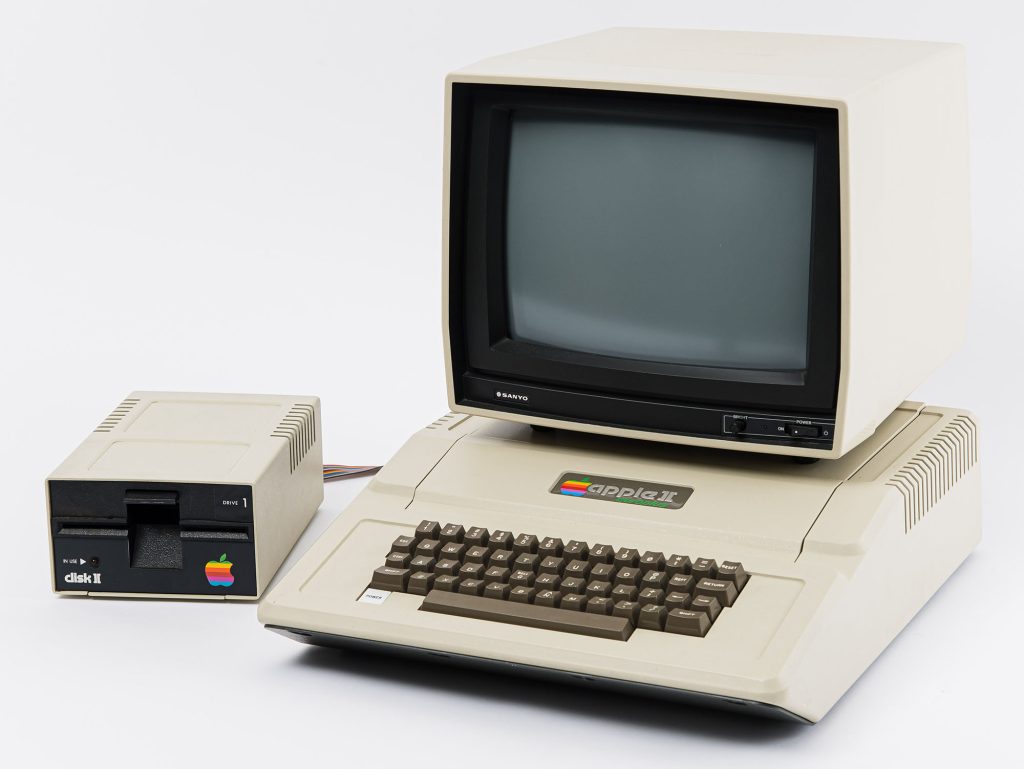
Photo: Heinz Nixdorf MuseumsForum & Sergei Magel/CC4.0
My introduction to Apple came in the form of the Apple II. While I never owned one, I started my tech career writing educational software for schools, and much of that was done on and for the Apple II, which was still in very common use some six years after it launched.
The Apple II offered incredible capabilities for the money at the time. The combination of color graphics and expansion slots made it an easy choice for schools, and its relative affordability meant that it was the device that introduced personal computing to an entire generation of schoolchildren.
My programming career didn’t last long: while I very much enjoyed it, I found that I was unable to switch my brain off after work. I’d be trying to relax and it would still be busy mentally writing code. It was just six months before I switched to writing about tech – and there was of course an Apple II in our computer lab when I joined the staff of Personal Computer World magazine in 1983.
LISA
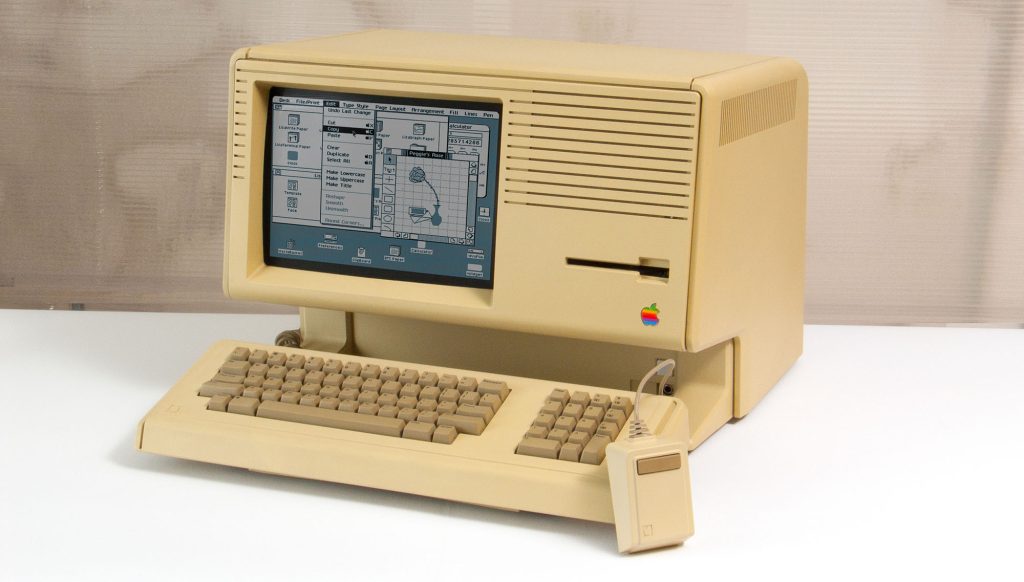
The launch of the LISA in 1983 was a huge moment. However, as revolutionary a machine as it was, it was not remotely affordable even for most businesses, let alone personal users. Most people at the time didn’t even know that it existed.
The real value of the LISA was serving as a proof of concept for the machine that followed it. For that reason, I’m going to move swiftly on to …
The OG Macintosh
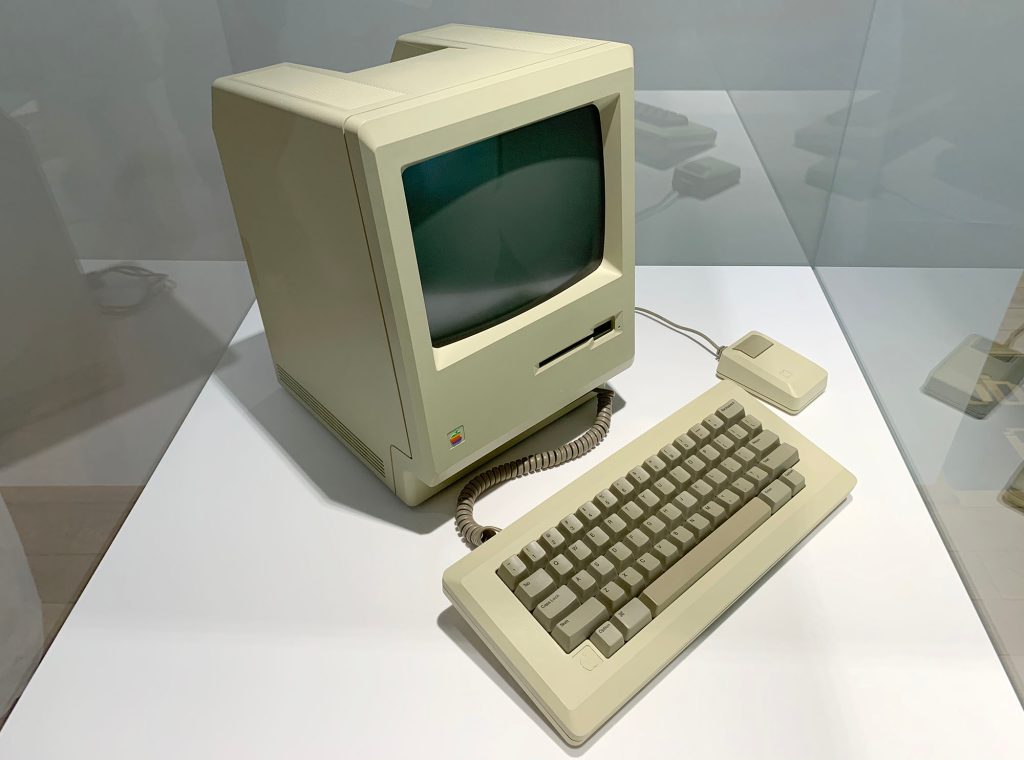
If I had to pick one Apple product that made a bigger difference to my life than any other, it would have to be the original Macintosh in 1984. It brought all of the key features of the LISA to a more portable and somewhat more affordable device, and it changed personal computing forever.
I’ve written a couple of love letters to that machine some ten years apart, so I’ll simply quote here from one of them.
Anyone who wasn’t alive at the time, or at least old enough to use computers, will find it hard to imagine what using a personal computer was like before the LISA and Macintosh, but there’s an easy way to get the idea: Open up Terminal on your Mac.
Yep, you would start up your PC to see a very similar prompt, and have to type commands to do anything – like change folder or open an app.
When you wrote in a wordprocessor, and wanted to use bold or italics, you would use keystrokes to do it – and you wouldn’t see a representation of the effect on your screen, you’d instead see the character codes. You’d only get to see the actual type effects when you printed the document.
Then came the Macintosh
It smiled at you as it started-up. You didn’t have directory listings, you had images of folders. You didn’t type the name of an application or file to open it, you used this strange new thing called a mouse to double-click it. When you made a word bold, it appeared in bold on the screen. You had different typefaces! It could talk to you! (Kind of … that is, you could type something and it would speak it.)
It was incredible. I immediately knew this was what computers were supposed to be like. I wanted one.
Even with the generous journalist discount Apple used to offer in those heady days, it cost me about a third of my annual salary. I didn’t care, I had to have one. I took delivery of the seventh Macintosh to arrive in the UK.
The Macintosh Portable
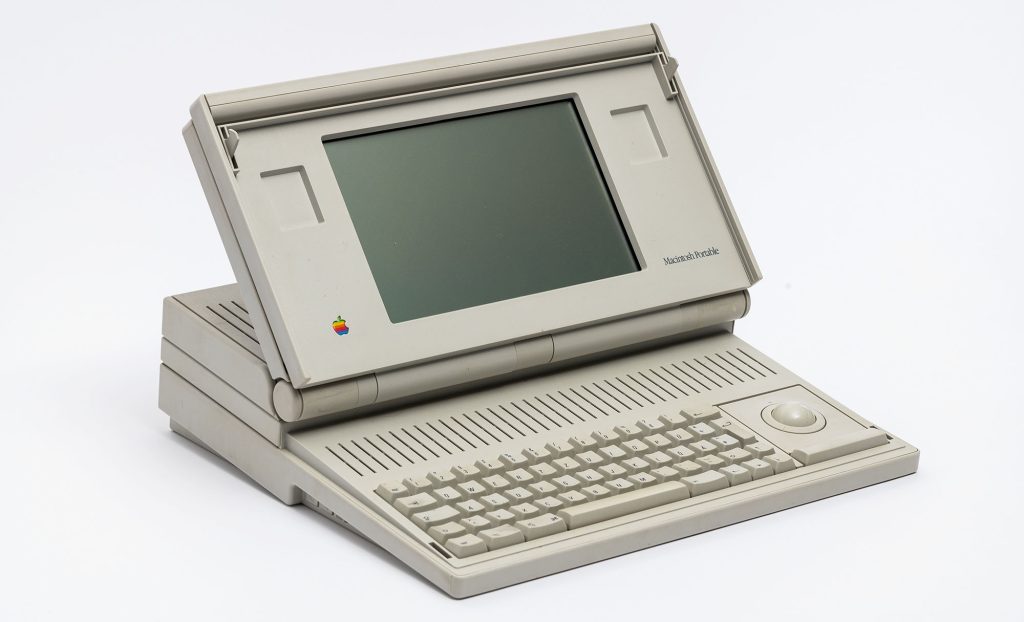
Photo: Heinz Nixdorf MuseumsForum & Sergei Magel/CC4.0
The original Macintosh was what was then termed a “luggable” computer. That is, it couldn’t be used on battery power but was still just about small and light enough to be lugged around with you, albeit not very easily. All the same, I loved my Macintosh enough to drag it between home and office and even took it on a few trips with me.
The Macintosh Portable was essentially the original Macintosh in an admittedly huge clamshell form with a lead-acid battery that was good for an hour or two at a time.
It was obscenely expensive, and I only managed to get my hands on one through good fortune. In truth, it mostly still served as a luggable machine, but it was at least sufficiently portable that I could lug it around with me relatively routinely.
The PowerBook 100
Photo: Klaus with K/CC3.0
The PowerBook 100 (slightly later PowerBook 150 shown) was the first machine that we’d really recognize as a predecessor to the MacBook models we have today. It finally transformed the Mac into something which was truly portable and which could be used on battery power alone for more than an hour or two.
This was the machine which completely converted me to a laptop guy, and I’ve never owned a desktop Mac since.
The OG iPod
Photo: Miguelon756-5303/CC4.0
I’ve also written a love letter to the original iPod and I’ll again quote from that. It replaced my previous MP3 player, which had just enough storage to store a single album at a time, with Apple’s promise of a thousand songs in your pocket.
Arthur C. Clarke famously said that any sufficiently advanced technology is indistinguishable from magic, and even months later I still felt that way about my iPod. I almost never left home without it.
A couple of years later, I upgraded to the 30GB model, which allowed me to have a significant proportion of my entire music collection loaded at any one time. 2007 completed my iPod journey with a 160GB model: I cannot tell you just how happy it made me to be able to have access to my entire music collection anywhere, anytime. Whether I was just commuting locally or on the other side of the world, I could simply think of an album and immediately play it.
Today, of course, streaming music takes things a step further. We don’t even have to own an album in order to be able to play it anytime, anywhere. That too kind of feels like magic. But I don’t think any music technology step since has ever quite matched the amazing feeling of loading up that first iPod on the day it went on sale.
The 17-inch MacBook Pro
That PowerBook 100 in 1991 had made me a laptop guy, but I still wanted the largest screen possible even when I was away from home. To me, the 17-inch MacBook Pro offered the best of both worlds.
The screen was large enough that I could use it for things like photo editing without needing to use an external monitor, but it was still sufficiently portable to carry around relatively routinely.
I loved the form factor so much that when Apple saddened me by discontinuing the machine, I immediately sold the three-year-old one I owned at the time in order to replace it with the final model in order to maximize its useful life.
It was also a very upgradable machine. Immediately after buying it, I upgraded the RAM and swapped out the optical drive for a second hard drive, and later replaced the spinning metal drives with SSDs.
I later got used to 16- and 15- inch displays, but I do keep an eye on occasional talk of some kind of 19-20-inch device further down the line.
The OG iPad
I’m no longer really an iPad guy, effectively replacing my 12.9-inch iPad Pro and Magic Keyboard with a 13-inch MacBook Air. I do still have an iPad mini, but it sees very little use.
All the same, the importance of that original iPad can’t be overstated. Apple almost single-handedly created a mass market for an entire new device category. We may joke that a large proportion of sales are for parents to give to their kids to keep them quiet, but getting those kids into the Apple ecosystem at such an early age is an impressive achievement.
There are also applications where only the tablet form factor makes sense and Apple absolutely dominates that sector of the industry.
The iPhone 4
I was a relatively late adopter of the iPhone, not buying one until the iPhone 4S. That’s because I was a very early adopter of smartphones and was a huge fan of physical keyboards. I especially loved the micro-laptop clamshell form factor of devices like the Nokia Communicator.
It was the Apple ecosystem rather than the iPhone itself which finally persuaded me to change. It’s somewhat ironic now that the introduction of Siri in the iPhone 4S was the development that made me feel I’d made the right choice! At that time, iPhones felt like the future with other smartphones being left behind …
The 11-inch MacBook Air
Although I loved my 17-inch MacBook Pro, even I had to admit that there was no way in the world to carry that on a two-week cycle touring holiday!
I wanted a Mac to transfer routes plotted in Garmin’s desktop software to my GPS device and also to blog my trips. I bought the 11-inch MacBook Air and absolutely adored its portability. It was this machine which turned me into a two-Mac guy.
My 13-inch MacBook Air is its spiritual successor, but I would still be open to a modern 11- or 12-inch machine. Especially now we have the MacBook Neo, I do see a potential gap in the lineup for a super sleek, super portable MacBook Air, which performs the role the 12-inch MacBook once did.
The OG HomePod
My HomePod Diary series charts my progression from HomePod skeptic to a man who now has at least one of the original HomePods in each room.
Back in 2020, I described it as a widely misunderstood product and echoed that when the original model was discontinued the following year. I acknowledged that it was an expensive and not overly intelligent smart speaker, but said that wasn’t the point.
The original HomePod is not a smart speaker. It’s a really amazing value mid-range wireless speaker that is almost unrivaled in its price range. It uses audio technology that debuted in speakers costing tens of thousands of dollars, and was previously unavailable in anything costing less than four figures. Oh, and as the icing on the cake, it’s also smart.
I have stereo paired OG HomePods in both my lounge and home office and still absolutely love them.
Apple Silicon Macs
Apple Silicon Macs of course revolutionized the lineup. They brought an absolutely insane combination of performance and battery life, and my own introduction to this was the M1 Max MacBook Pro. I described it as a night-and-day improvement over my previous Intel machine, both for more demanding tasks like 4K video editing and in everyday use.
My MacBook Pro didn’t break a sweat. The edit process (with 4K dual-camera source footage) was buttery smooth; the render of the 3m 11s video to H.264 HD format took exactly 19 seconds; and the Mac remained completely cool, with zero fan usage […]
My Intel machine would get uncomfortably warm when used as a laptop, and the fans would kick in quite regularly, even in everyday use. Battery life was also around five hours. This machine doesn’t ever get warm. The fans never come on. And battery life is now exceeding 10 hours of real-life use, including a decent chunk of that on full brightness.
Honorable mentions
I have to end with a few honourable mentions.
I loved the way that the original iPhone SE restored the slab-sided look I loved about earlier iPhones and the pocketability of the device.
The iPhone X was the first iteration of an entirely new iPhone design and the first step in the company’s continuing journey toward that single slab of glass vision.
My Apple Watch was subsequently replaced with a smart ring, but I would have to acknowledge the undeniable impact on the world of Apple’s smartwatch. It took the company a little time to realize the USP was health rather than notifications, but once it did so, it really went all-in on that role. It has saved many lives and will save many more in the future.
More personally, the iPhone 11 Pro was the first point at which I felt it was good enough to serve as an everyday camera. The iPhone 14 Pro graduated to passing the travel photography test also, and the iPhone 15 Pro’s ability to record video directly to an external SSD has made it a much more capable B-cam/C-cam for video projects.
What are your picks?
Those are my standout Apple products over the last 50 years. What are yours? Please share in the comments.